

Social Media and Adolescent Mental Health
A Meta-Analysis of Longitudinal Evidence
This meta-analysis pools longitudinal studies from 2018–2024 that tracked adolescent social media and screen use against depression and anxiety.
Eleven studies are pooled with DerSimonian-Laird random-effects estimation, harmonizing every effect to the Pearson correlation scale. The pooled association is r = 0.035 (95% CI 0.005–0.065) — small but statistically significant.
The more interesting result is why the studies disagree. Roughly two-thirds of the variation is real disagreement between studies, and most of it traces back to how they measured exposure and outcomes rather than to the platforms themselves.
How strong is the longitudinal association between adolescent social media use and depression or anxiety once studies are pooled — and how much of the disagreement between studies comes from measurement method rather than a true difference in effect?
Whether social media harms adolescent mental health is one of the most contested questions in contemporary social science, and individual studies report everything from null to sizeable effects. Meta-analysis can pool that evidence into a single estimate, but the answer is only as clean as the studies going in: effects here are measured with different instruments (CES-D, GAIN-SS, CIS-R, SDQ), different exposure definitions (general social media, specific platforms, broad screen time), and — in seven of eleven studies — reported only as null associations. This review harmonizes all of them to a common correlation scale, pools them with random-effects estimation, and then stress-tests the headline number with leave-one-out checks, publication-bias tests, and a direct-versus-indirect measurement comparison.
- Pooling 11 longitudinal studies gives a small but significant association between adolescent social media use and depression or anxiety (r = 0.035, 95% CI 0.005–0.065)
- The effect is robust — leave-one-out pooling stays within r = 0.029–0.040, and trim-and-fill for publication bias barely moves it (r = 0.040)
- Measurement method drives most of the heterogeneity: restricting to direct-reported studies raises the effect 2.4× to r = 0.083 with zero heterogeneity (I² = 0%)
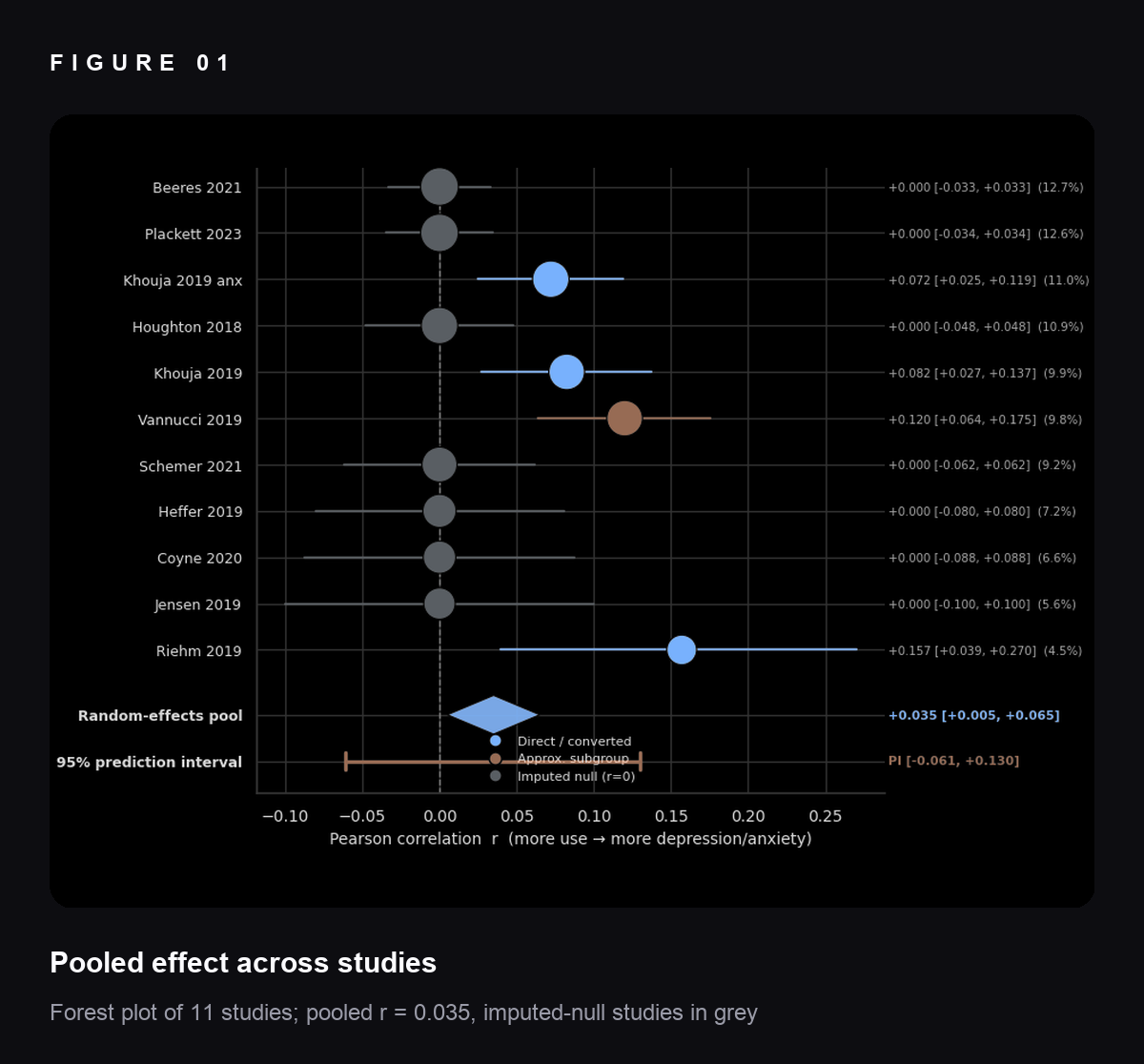
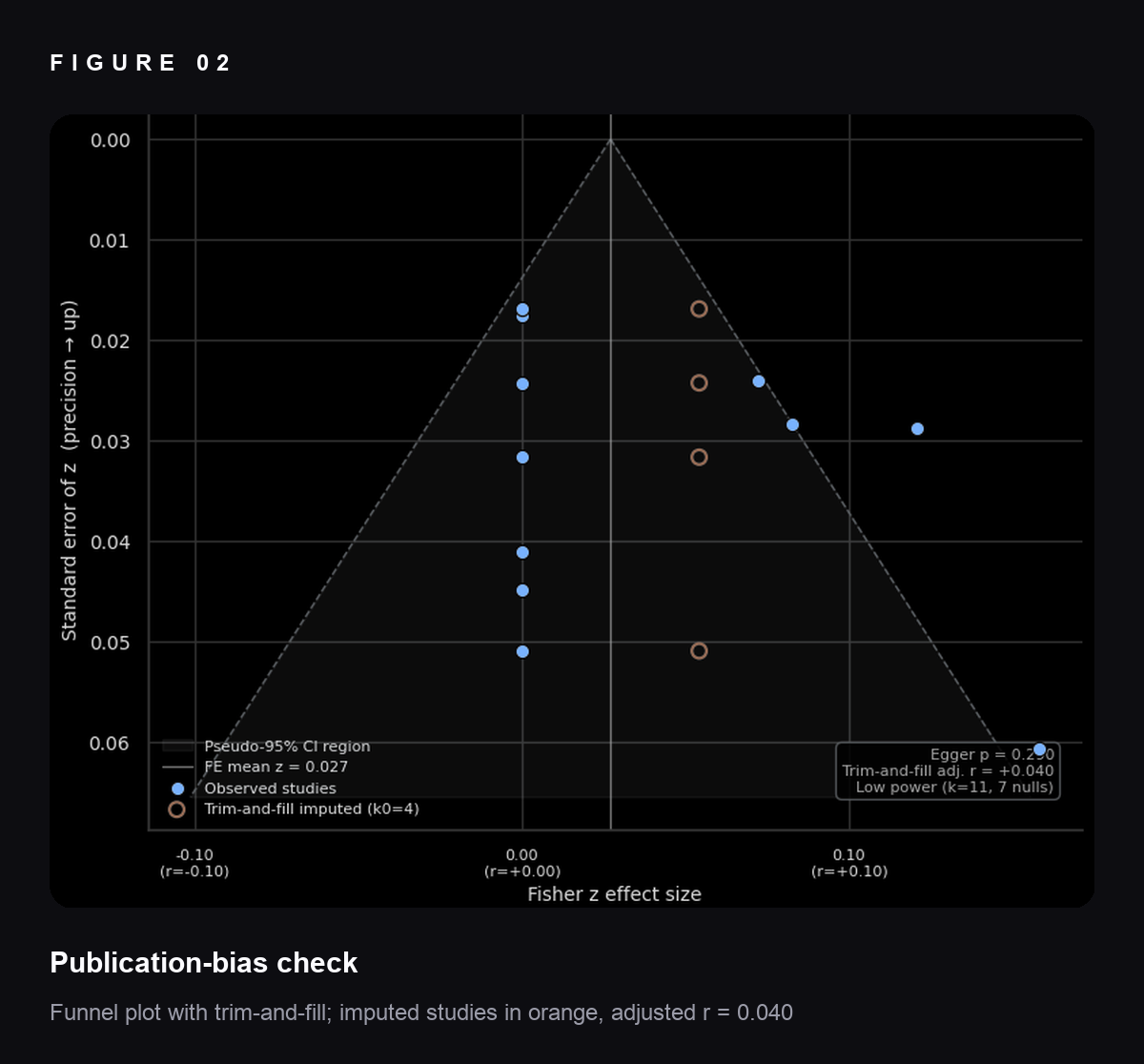
Seven of the eleven studies contribute imputed null correlations (r = 0.000), reconstructed from reported non-significant results. This preserves information from every published study but reduces variation and could slightly bias the pooled estimate if genuine small effects were reported as null.
With so many imputed nulls, Egger's test and trim-and-fill have limited power, so the absence of detected publication bias does not rule it out. The headline r = 0.035 is an average across methodologically diverse studies rather than a population-level estimate — direct-report studies suggest the association may be stronger than the overall average implies.
Subgroup analyses by platform and instrument often rest on one or two studies per cell, so between-group tests are not significant and the patterns are exploratory. Samples are adolescent and drawn largely from North America, Europe, and the UK and Australia between 2018 and 2024, limiting generalizability.