

Intergenerational Economic Mobility
ACS Co-Resident Proxy Replication and Validation
This replication builds an intergenerational economic mobility estimator from American Community Survey (ACS) co-resident parent-child income pairs — using only publicly available data.
The study constructs a national dataset of 241,379 parent-child pairs across all 51 states, allocates them to 652 commuting zones, and estimates rank-rank slope and absolute upward mobility for comparison against the Chetty et al. (2014) tax-record benchmarks.
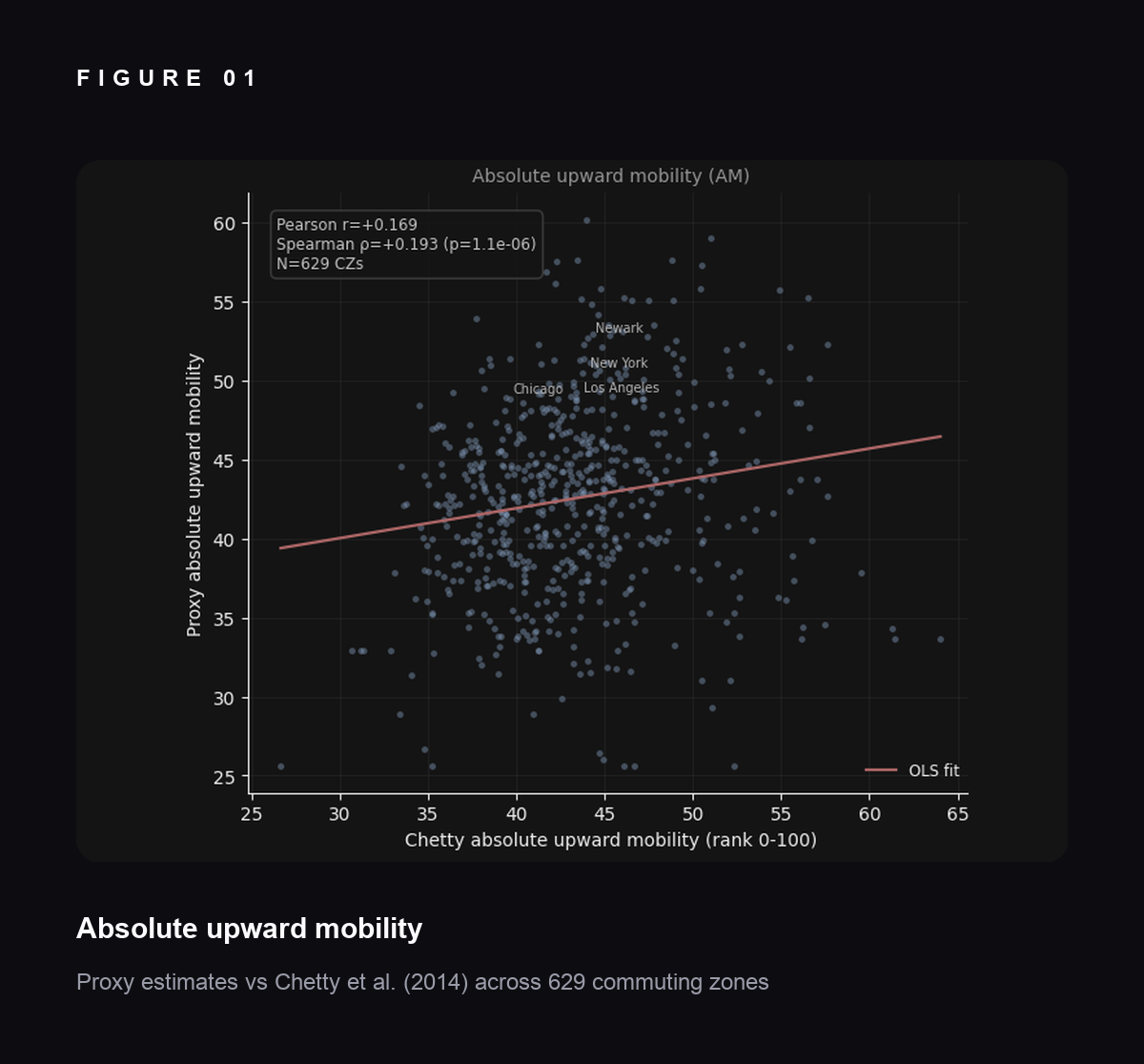
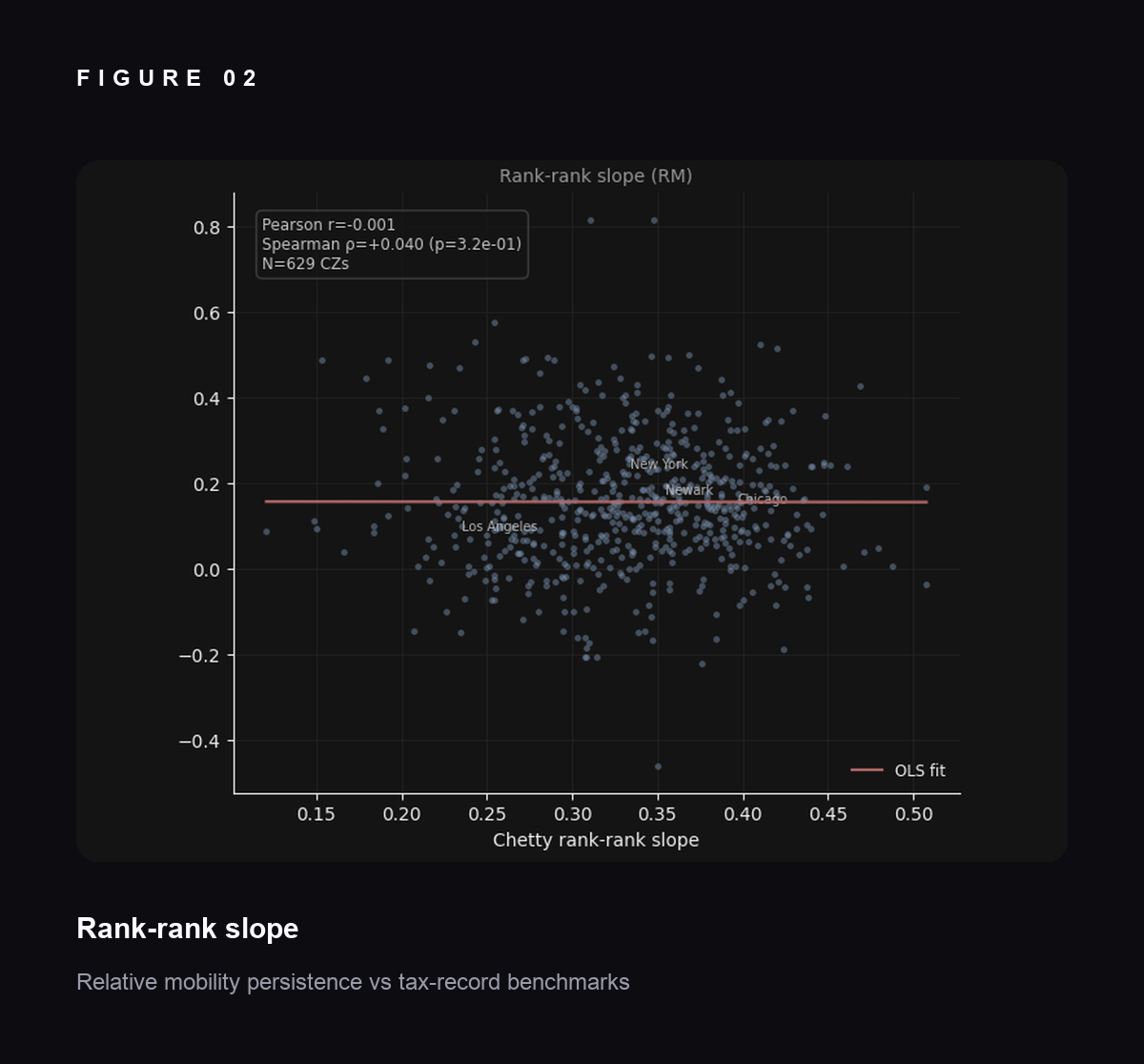
The result is a validated map of where public data can stand in for restricted tax records. Absolute upward mobility reproduces the benchmark levels almost exactly, and where the rank-rank slope diverges, the pipeline quantifies the gap and decomposes it into co-residence selection, income measurement, and cohort effects — turning a data limitation into a measured, documented result.
Can co-resident parent-child income pairs from public ACS survey data reproduce the intergenerational mobility estimates that Chetty et al. (2014) derived from federal tax records?
Intergenerational mobility research asks how strongly a child's economic outcomes depend on their parents' income. The benchmark estimates in this literature — Chetty et al. (2014) — were built from federal tax records covering millions of parent-child links, data most researchers cannot access. The co-resident proxy approach instead identifies adult children (ages 25–30) living with their parents in ACS Public Use Microdata Samples, observing both generations' incomes in a single household snapshot. This replication tests how far that reproducible, publicly available shortcut can go: pairs are allocated from PUMAs to commuting zones through population-weighted crosswalks, and mobility metrics are estimated wherever at least 50 pairs are observed.
- A national mobility estimator was built entirely from public data — 241,379 co-resident parent-child pairs across all 51 states, covering 652 commuting zones
- Absolute upward mobility matched the Chetty et al. tax-record benchmark — a mean of 42.4 percentile points vs 43.2, with a statistically significant correlation (r = 0.169)
- The validation pipeline quantified a −0.18 rank-rank slope gap versus tax records and isolated its drivers: co-residence selection, single-year income measurement, and cohort span
The co-resident approach observes only households where adult children live with their parents, excluding the majority of young adults who have left home. Individuals who co-reside may differ systematically in family stability and economic circumstances, introducing selection bias into the mobility estimates.
Incomes are single-year ACS observations, while Chetty et al. use multi-year averages from tax records — classical measurement error that dampens rank-rank slopes. The proxy sample also uses 2022 PUMS data for children ages 25–30 against benchmarks built for the 1980–82 birth cohorts, so cross-cohort comparisons span more than 40 years of potential change.
Geographic allocation relies on 1990-vintage commuting-zone crosswalks, and five pseudo-PUMA combinations could not be mapped (7.7% of the national sample). Zones with fewer than 50 pairs are excluded, tilting coverage toward metropolitan areas, and zero and negative incomes are retained in the primary estimates.