

CRISPR Off-Target Meta-Analysis
Pooled Rates and Drivers of Activity
This meta-analysis pools CRISPR off-target indel rates across 85 studies using random-effects logit-scale meta-analysis, then asks what drives the variation between them.
The pooled estimate is 4.12% (95% CI 3.31–5.12%) — roughly four off-target indels per hundred target attempts — but a wide prediction interval (0.86–17.57%) and high heterogeneity (I² = 72%) show a single number tells only part of the story.
A mixed-effects meta-regression accounts for most of that spread: delivery method, Cas variant, and detection assay explain the bulk of the variance, and the analysis quantifies how much of the reported rate is biology versus methodological choice.
How large is the CRISPR off-target indel rate once results are pooled across studies, and how much of the variation is driven by guide and target biology versus experimental and analytical choices?
CRISPR editing can cut unintended genomic sites, and off-target rates reported across the literature vary widely — the product of different delivery methods, Cas9 variants, detection assays, and guide designs, not one underlying number. Meta-analysis of proportions is also technically delicate: off-target screens produce many zero-event studies, and the standard fixes (continuity corrections, transformation choices) can materially move the pooled estimate. This review pools 85 studies on the logit scale, runs a mixed-effects meta-regression across fourteen moderators to attribute the variation, and stress-tests the headline rate against five pooling methods and two publication-bias tests suited to proportions.
- Pooling 85 studies gives an off-target indel rate of 4.12% (95% CI 3.31–5.12%), with a wide 0.86–17.57% prediction interval and high heterogeneity (I² = 72%)
- A mixed-effects meta-regression explains 93.3% of between-study variance (R² = 0.933); delivery method, Cas variant, and detection assay are the strongest drivers
- Analytical choices dominate the headline number — continuity-corrected pooling runs 2.2–2.7× higher than correction-free methods, so a single rate must travel with its prediction interval
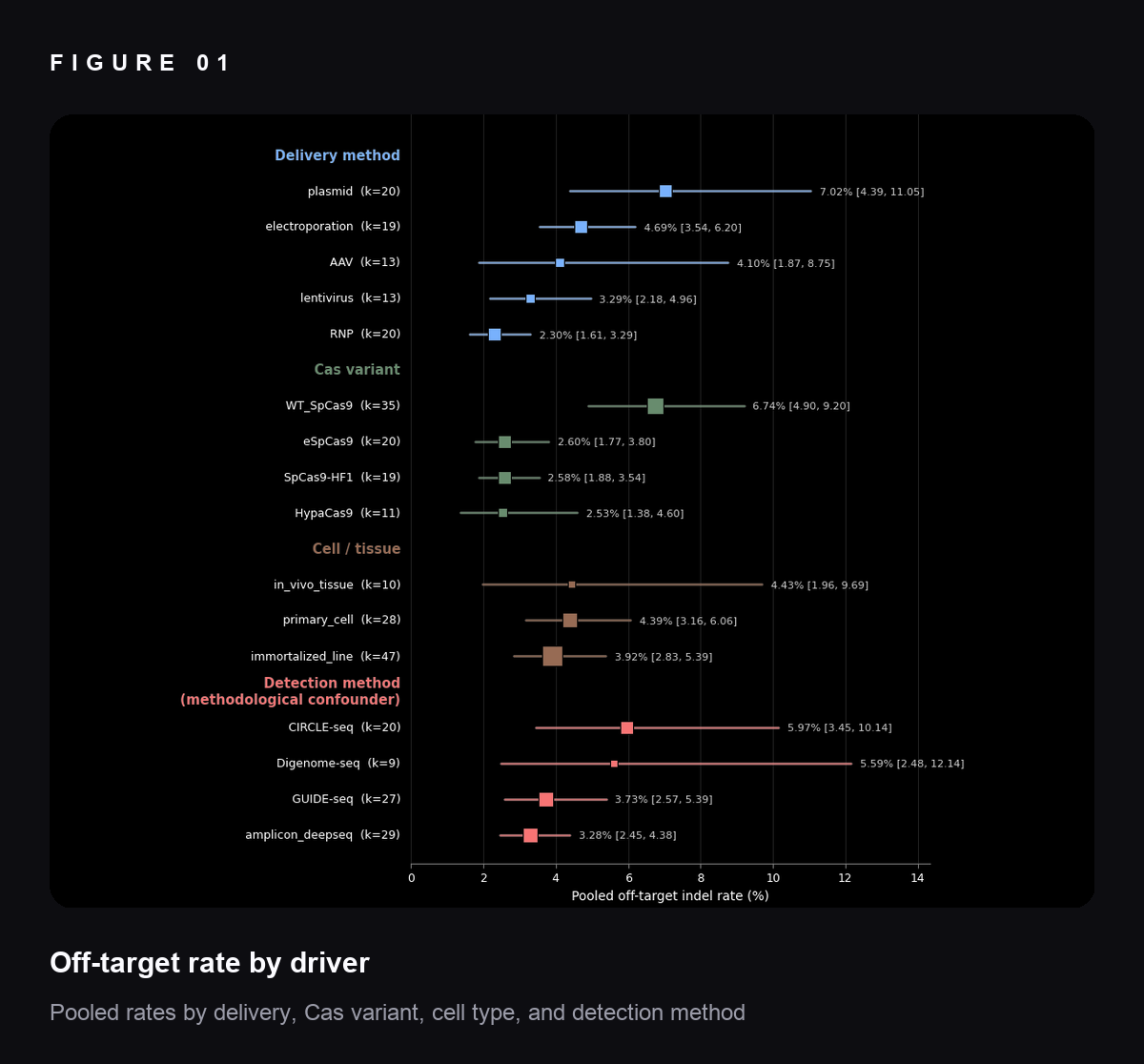
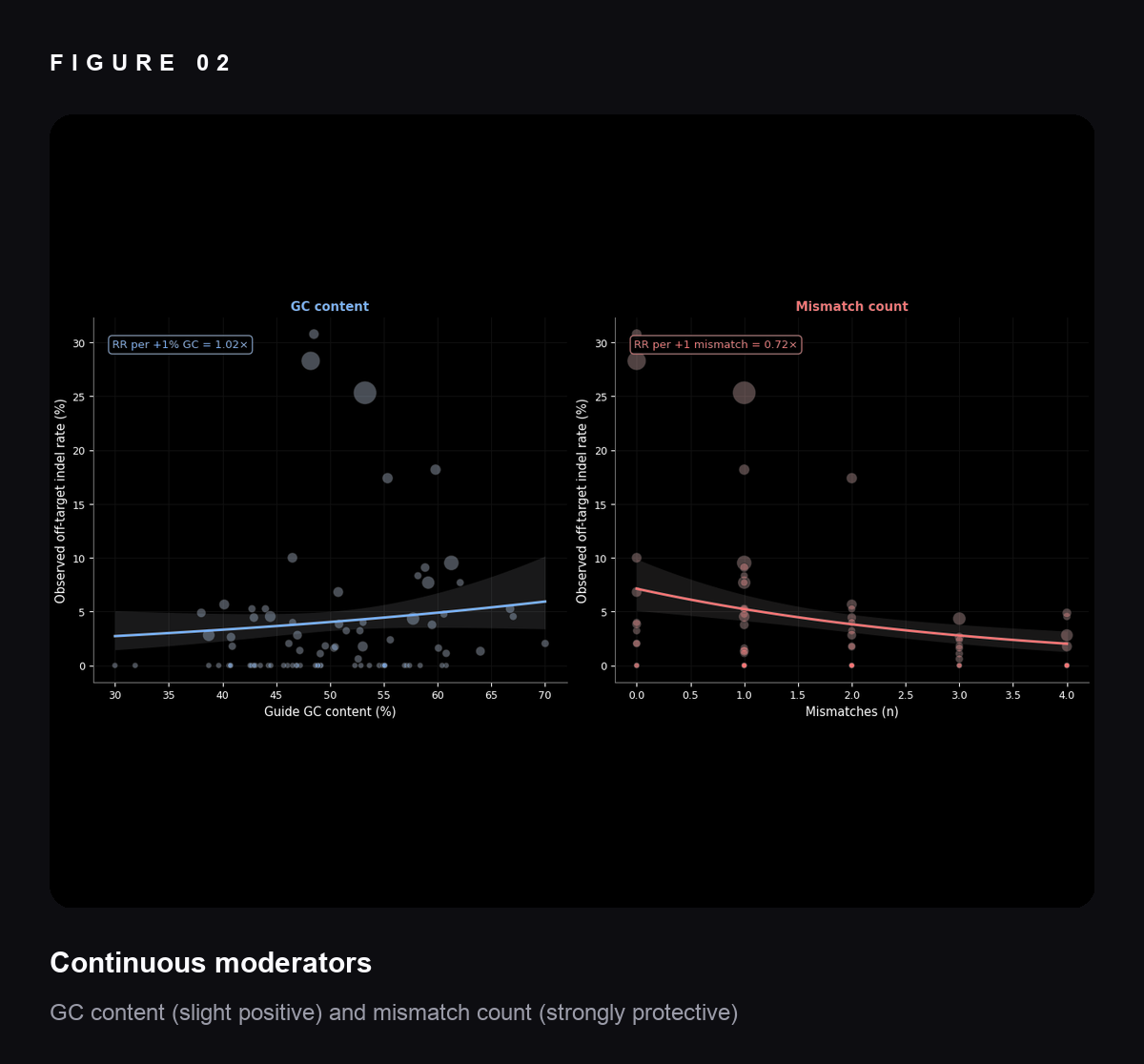
This analysis is based on simulated, illustrative data calibrated to literature-reported ranges, not actual published off-target studies. Findings should be read as a demonstration of the analysis workflow and interpretation rather than ground-truth estimates of CRISPR off-target burden.
The dataset includes 40 zero-event studies (47% of the total), so the choice of zero-handling method strongly shapes the estimate: correction-free pooling (GLMM) falls near 1.7%, while the continuity-corrected logit models behind the headline rate sit around 4% — a 2.2–2.7× difference. The reported number depends heavily on this analytical choice.
Substantial heterogeneity remains even after adjusting for measured moderators, and genome-wide detection assays nominate more sites than amplicon sequencing — a methodological, not biological, effect. Moderators are observational, so the regression quantifies association rather than causation, and unmeasured factors such as chromatin state may influence apparent effects.