Replicating the Corporate Bond Factor Zoo
Measurement Bias and the Limits of Investable Premia
This replication examines whether published corporate bond trading signals still generate alpha after correcting for known issues in TRACE transaction data.
The study rebuilds the corporate bond factor zoo, tests each signal in a Bond CAPM framework, and applies corrections for measurement bias, filtering bias, and multiple testing.
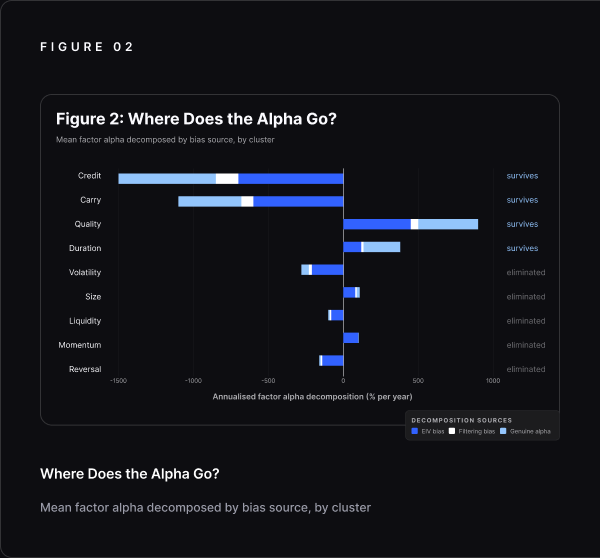
The main finding is that many apparent bond factor premia weaken or disappear after correction. The surviving signals are concentrated in economically meaningful fixed-income categories: duration, quality, carry, and credit.
Do published corporate bond factors represent genuine investable premia, or are many of them artifacts of measurement error in transaction-level bond data?
The “factor zoo” refers to the large number of published trading signals that appear to predict returns.
In corporate bonds, the problem is especially difficult because the underlying transaction data can be noisy. TRACE prices are affected by bid-ask bounce, sparse trading, and post-trade filtering. These effects can make some factors look profitable even when the apparent alpha is mechanical. This replication follows the methodology of The Corporate Bond Factor Replication Crisis to test how much of the corporate bond factor zoo survives after correcting for these issues.


Replication workflow
A summary of the end-to-end research process in Zerve.
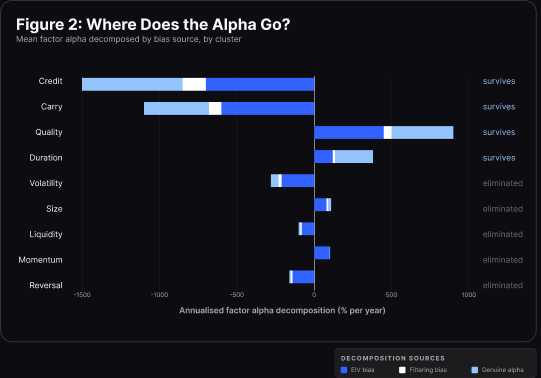
Where Does the Alpha Go?
Mean factor alpha decomposed by bias source, by cluster.
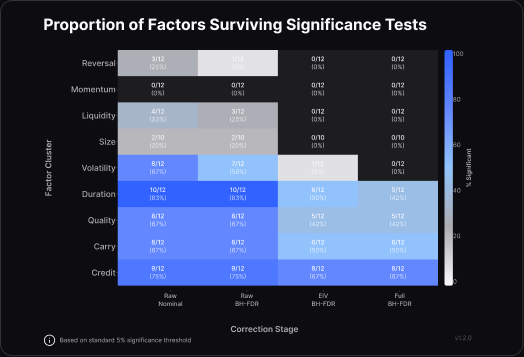
Proportion of Factors Surviving Significance Tests
Factor cluster vs. correction stage.
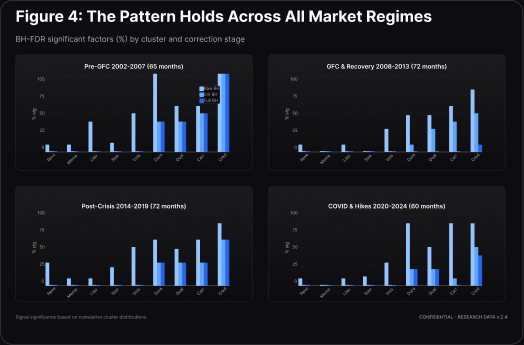
The Pattern Holds Across All Market Regimes
BH-FDR significant factors by cluster and correction stage.
- 011106 corporate bond factors were reconstructed across 9 factor clusters
- 022The sample covers 64,553 corporate bonds from September 2002 to December 2024
- 033Before correction, 52 of 106 factors were nominally significant
- 044After EIV and filtering correction, 29 of 106 factors remained nominally significant
- 055Under full correction and BH-FDR multiple-testing control, 24 factors survived
- 066Five clusters were eliminated entirely: reversal, momentum, liquidity, size, and volatility
- 077Survivors were concentrated in duration, quality, carry, and credit
Factor construction relies on the Open Bond Asset Pricing Stage 1 dataset derived from FINRA TRACE. Despite EIV and filtering corrections, residual measurement error in thinly traded or illiquid bonds cannot be fully eliminated.
The BH-FDR procedure controls the expected false discovery rate but does not guarantee that surviving factors represent genuinely investable premia. Statistical significance under the Bond CAPM framework is sensitive to the choice of market factor and model specification.
The 22-year sample period (2002–2024) spans multiple credit cycles, but structural breaks in liquidity conditions — particularly post-GFC and post-COVID — may affect factor stability across subperiods. Out-of-sample and live performance are not assessed.
Factor construction relies on the FINRA TRACE dataset. Despite corrections, residual measurement error cannot be fully eliminated. BH-FDR controls expected false discovery rate but does not guarantee absolute investable premia.